Why To-Do Lists Fail ADHD Brains (and How the Right App Fixes Them)
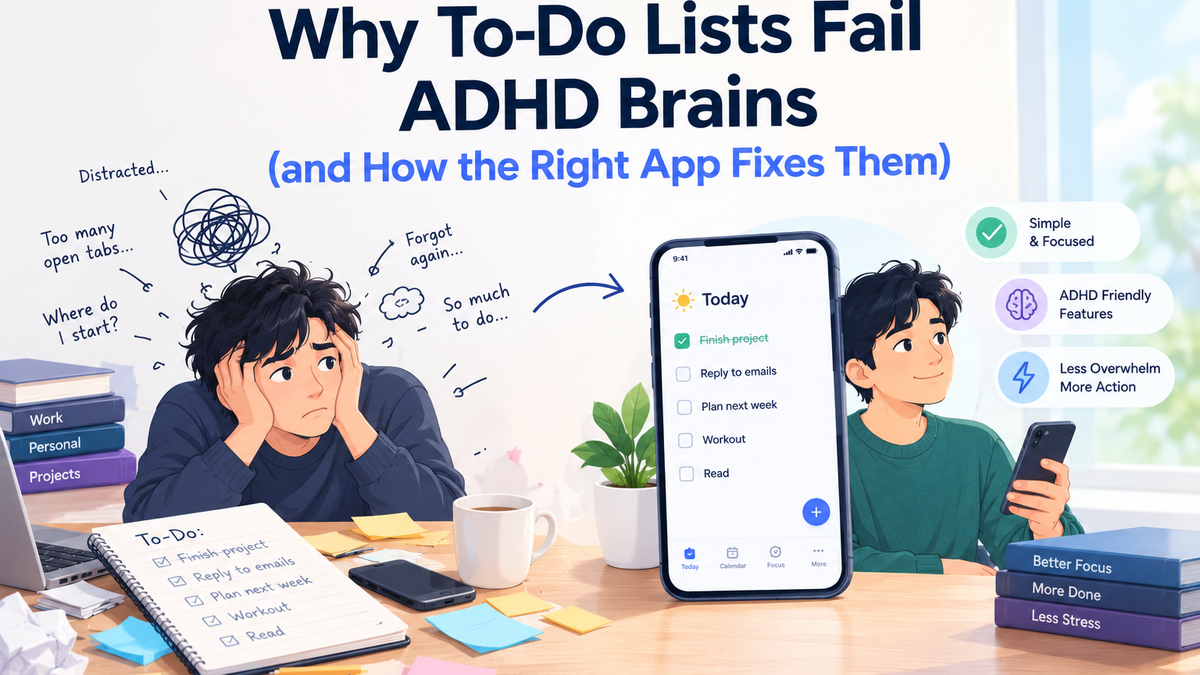
If you've ever written a to-do list, failed to finish it, and then written another one only to forget both exist, you're not alone. For people with ADHD, task management can feel like the brain is actively working against you. You jump from one task to another, picking each one back up with only a faint clue of where you left off. By the end of the day, you've finished neither.
Here's the thing: according to one of the world's leading ADHD researchers, you are not failing at task management. Your tools were never designed for your brain.
In this article, you'll learn what ADHD actually is, why traditional systems fail ADHD brains, and how, through the work of Dr. Russell Barkley, the right to-do app can genuinely help.
What Is ADHD?
Attention Deficit Hyperactivity Disorder (ADHD) is a neurodevelopmental condition that affects the brain's executive functions: the mental skills you need to plan, focus, remember instructions, and juggle multiple tasks. It shows up in both children and adults, and it goes far beyond "being distracted."
People with ADHD often experience:
- Inattention: trouble sustaining focus, especially on tasks that aren't stimulating
- Time blindness: losing track of how long tasks take and how much time has passed
- Working memory issues: forgetting tasks, appointments, and deadlines moments after learning them
- Task paralysis: feeling so overwhelmed that starting seems impossible
- Difficulty prioritizing: seeing everything as equally urgent (or equally unimportant)
- Object and task permanence: applying "out of sight, out of mind" to to-do lists, too
These challenges come from differences in dopamine regulation and prefrontal cortex function, and they have nothing to do with laziness or intelligence.
The Scientist Who Changed How We Understand ADHD
Dr. Russell Barkley is a clinical psychologist and one of the most-cited ADHD researchers in the world. His model reframes ADHD as a disorder of executive function and self-regulation, a difficulty regulating your own behavior toward the future, rather than a simple deficit of attention.
Two of Barkley's insights explain nearly everything about why to-do lists fail ADHD brains, and why the right app can fix the problem.
Insight #1: "Knowing What to Do" vs. "Doing What You Know"
As Barkley puts it, ADHD is a disorder of doing what you know rather than a disorder of knowing what to do.
Most people with ADHD know exactly what they should be doing. The breakdown happens in the moment of performance, when knowledge fails to turn into action at the right time. That's why lectures, planners, and "trying harder" fall short: they add more knowledge to a brain that already has plenty of it, without addressing the performance gap.
Insight #2: Interventions Must Happen at the "Point of Performance"
Barkley's most famous clinical principle is the point of performance. Support and cues must arrive at the exact time and place the behavior is needed. A reminder written in a planner that morning is useless if you never open the planner at 3 p.m., when the task actually needs doing.
Barkley concludes that because ADHD impairs the internal systems of self-regulation, supports must be external. He calls this the externalization principle: getting information, time, and motivation out of the brain and into the visible environment.
The ADHD brain can't reliably hold information, sense time, or generate motivation internally. The environment has to do it instead.
This is the scientific foundation of the "external brain" idea. It is also exactly what a well-designed to-do app provides.
How To-Do Apps Put Barkley's Principles into Practice
Every effective to-do app feature maps directly onto one of Barkley's principles. Here's the connection:
1. Externalizing Information → The External Memory
Instead of relying on faulty working memory, you keep everything in one trusted place. This is the externalization principle in its purest form: the app remembers for you, so your brain can focus on doing the work instead of holding the list.
2. Reminders at the Right Moment → The Point of Performance
This is the big one. Smart, time-based reminders and notifications deliver the cue at the moment the behavior is needed, precisely where Barkley says interventions must occur. A 5 p.m. alert saying "start dinner prep" works when a morning note saying "remember dinner" never would.
3. Timers and Visual Timelines → Externalizing Time
Barkley describes time as largely invisible to the ADHD brain, a kind of "temporal myopia" in which the future feels abstract and distant. Timers, countdowns, and visual day timelines make time physical and visible, pulling the future into the present, where action can happen.
4. Gamification → Externalizing Motivation
ADHD brains struggle to generate internal motivation for low-stimulation tasks, because the reward is too distant and abstract. Points, streaks, and celebrations attach an immediate external reward to task completion, bridging the gap between action now and payoff later.
5. Subtasks → Making the Abstract Concrete
"Clean the house" is a vague, future-oriented abstraction, an executive-function nightmare. A step like "put the dishes in the sink" is concrete and immediate, the kind of action the brain can actually initiate. Apps with subtasks do this executive heavy lifting for you.
6. Recurring Tasks → Reducing Reliance on Memory
Automation removes routine tasks from working memory entirely. When the app handles the schedule, the brain no longer has to re-remember, re-plan, and re-decide the same things every day.
What the Research Says
Barkley's principles are well established in the clinical literature, and research on digital tools for ADHD is growing:
- A 2025 systematic review of ADHD management apps found that they can help users monitor symptoms and support daily cognitive functioning.
- Academic case studies of visual planning apps such as Tiimo have explored how assistive planning technology supports everyday ADHD management.
- Digital interventions for ADHD are now the subject of active clinical trials.
An honest caveat: most rigorous studies focus on clinical digital therapeutics rather than consumer to-do apps. Evidence for apps like Todoist or TickTick rests on Barkley's well-supported theoretical framework plus strong user-reported benefits. Apps can supplement professional treatment, but they cannot replace it.
That honesty matters. If you have ADHD, you've probably been burned by overhyped "productivity miracles." The Barkley model explains why apps help when they follow the right principles and why they fail when they don't.
The Bottom Line
ADHD is a performance problem, as Barkley's research shows. The problem was never your willpower or your knowledge. Performance can be engineered, and that is genuinely good news.
A to-do app designed around the point of performance and the externalization principle (reminders at the right moment, time made visible, motivation made immediate) never asks your brain to work harder. It takes the load off entirely.
If you're ready to put that into practice, start with an app that removes every barrier between you and your first task. Lakun is free, works offline, keeps your data private on your device, and gets you from install to first task in under five seconds, no account needed!
Quick Reference: The Feature-to-Principle Map
| App Feature | Barkley Principle | ADHD Challenge It Addresses |
|---|---|---|
| Central task capture | Externalization of information | Working memory failure |
| Timed reminders & notifications | Point of performance | "Doing what you know" |
| Timers & visual timelines | Externalization of time | Time blindness |
| Gamification & rewards | Externalization of motivation | Delayed reward processing |
| Subtasks | Making abstract goals concrete | Task paralysis |
| Recurring tasks | Automation over memory | Repeated forgetting |
Putting These Principles into Practice: Lakun
If you're wondering what an app built around these ideas looks like, Lakun is a great example.
⚡ A five-second start (no account required). Barkley's biggest warning is friction at the point of performance: if capturing a task takes effort, ADHD brains will not do it. You can install Lakun, open it, and capture your first task in under five seconds. There is no signup wall and no onboarding marathon.
✅ Subtasks. Turn "clean the house" into small, brain-friendly steps, exactly the kind of breakdown that defeats task paralysis.
⏰ Deadlines and priorities. Time becomes visible and concrete, and priority labels answer the eternal ADHD question: "What do I do first?"
🗂️ Categories. Everything lives in one trusted external brain (work, home, personal), so nothing relies on your working memory.
🔒 Local-first and distraction-free. Your tasks stay on your device, offline-ready, with optional end-to-end encrypted sync. There are no feeds and no noise. You get a calm, fast list that respects your focus and your privacy.
💸 Free. No subscription blocks you from trying the system that might finally stick.
👉 Try Lakun free, available on iOS, Android, macOS, Windows, and Linux.
Sources & Further Reading
- Dr. Russell Barkley, official website with fact sheets, lectures, and resources: russellbarkley.org
- CHADD: ADHD education and support
- ADDitude Magazine: practical ADHD strategies
- Applications for the management of ADHD: a systematic review (2025), on PubMed